Engineering Services
Excudion Battery Design Tool
Your cell, unequivocally defined.
Define sharp cell-level requirements. Simulate and predict. Validate your cell virtually — months before the qualification gate and years before launch.
How it works
One model, from cell design to the next decision
Our in-house, physics-based cell design and simulation platform, inside every engagement.
- 1
Design
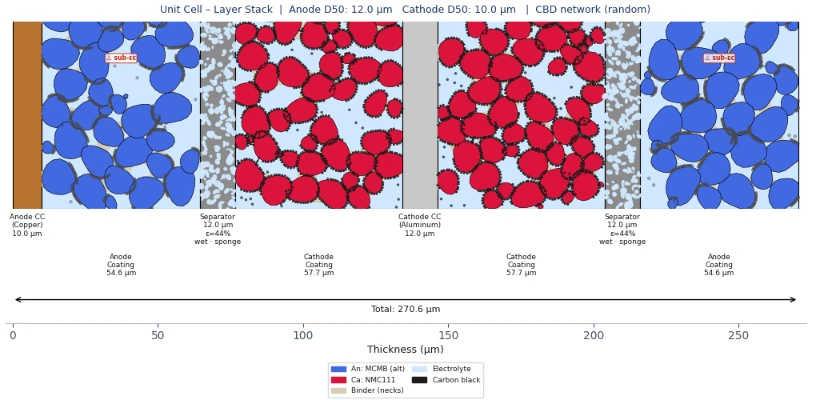
Built from the stack: electrodes, balance, geometry, formation.
- 2
Test data
Your existing cycler files: OCV, GITT, rate tests, cycling.
- 3
Calibrate
Each parameter from the test that sees it, with a credible interval.
- 4
Simulate
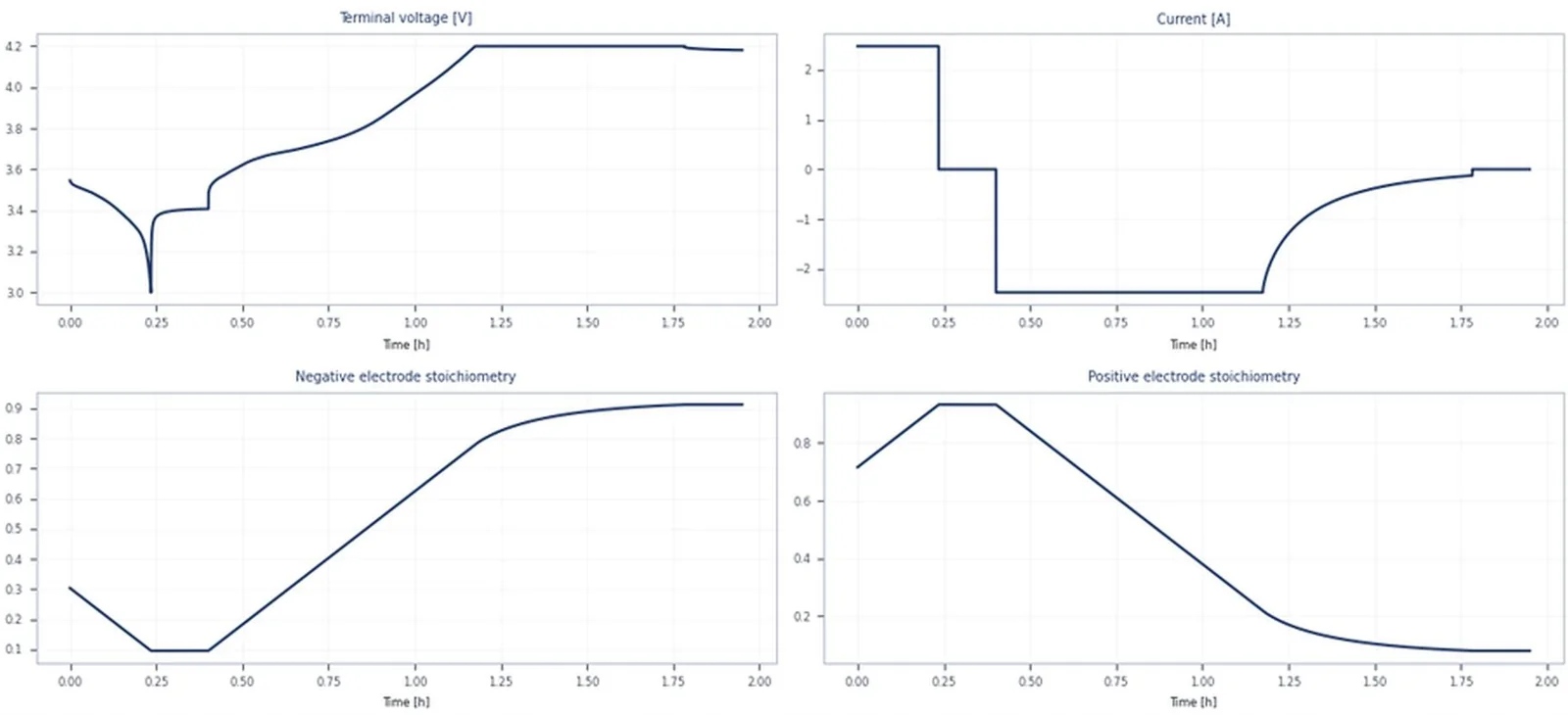
Any protocol or duty cycle on the calibrated cell: voltage, heat, stoichiometry.
- 5
Decide
The cell, the specification, or the next test worth running.
The cell
A cell, modelled from the stack up
Calibration
Calibration and validation, with equal weight
Every fit keeps its record.
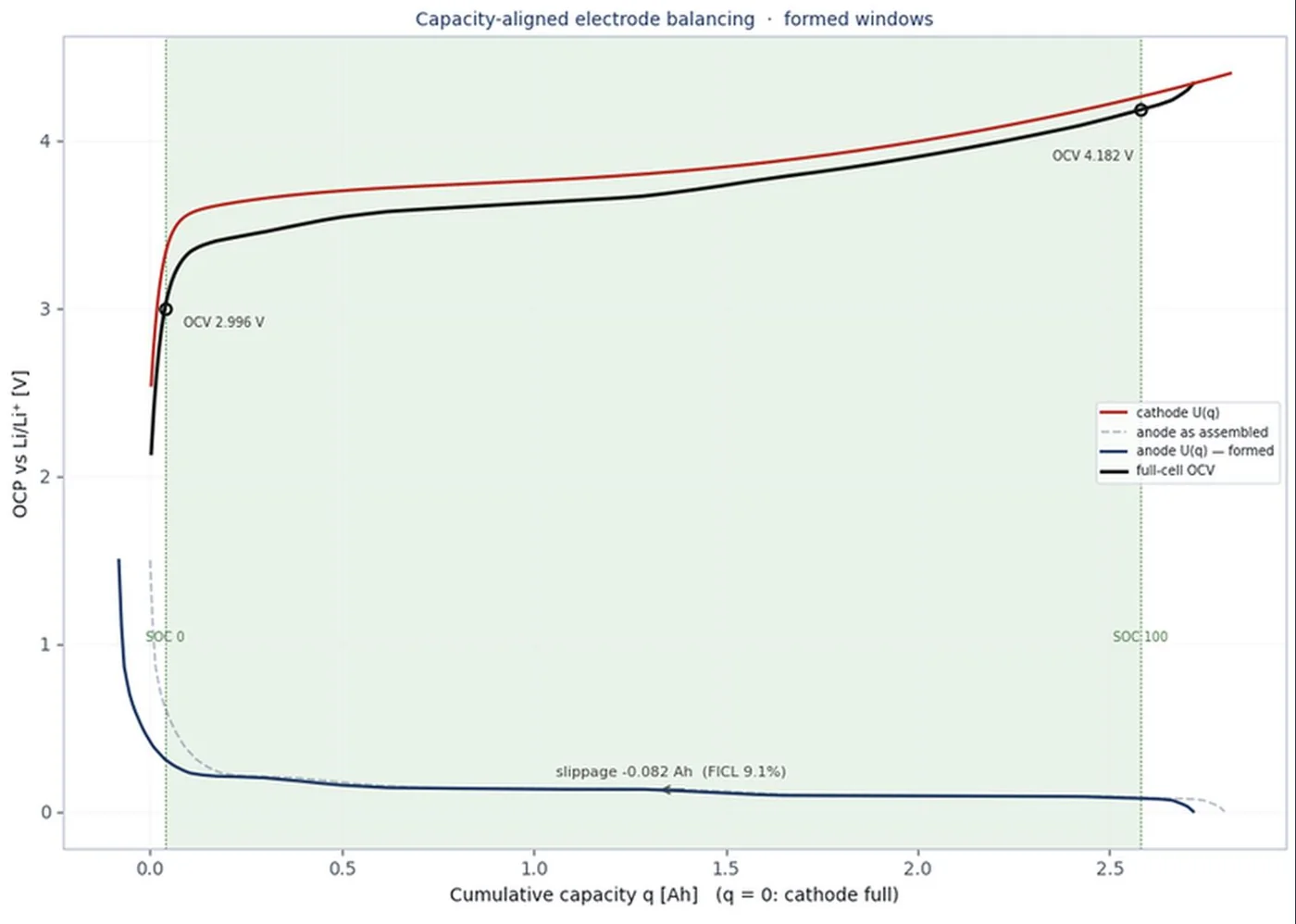
- Parameters identified in stages: formation, thermodynamics, kinetics and diffusivity, transport.
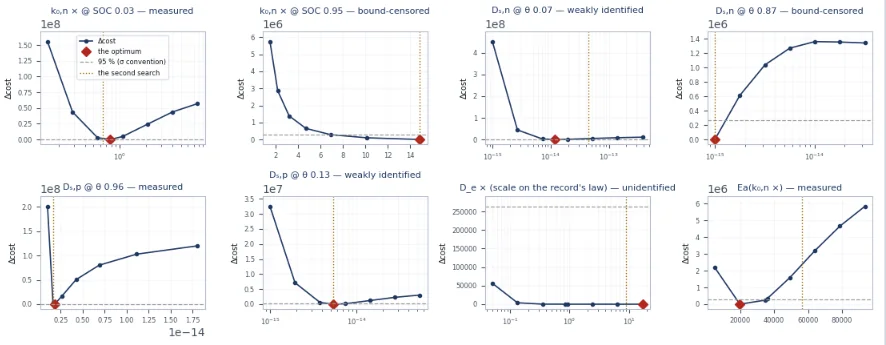
- A sensitivity map first: what your data can identify, and what it cannot.
- Data windows, residual and a credible interval on every parameter.
- An audit report: the evidence is there to be found, not taken on trust.
Validation
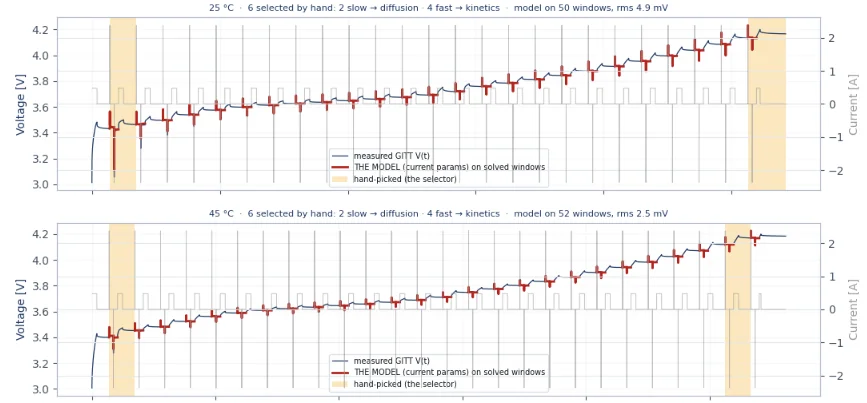
Then the whole test, not just the fitted pulses
Six pulses per train are used for the fit, two slow for diffusion and four fast for kinetics. The calibrated model is then run over every pulse.
Identifiability
It also shows what your data cannot see
Simulation
Then any protocol runs on the calibrated cell
Design study
See the spread before you build the cell
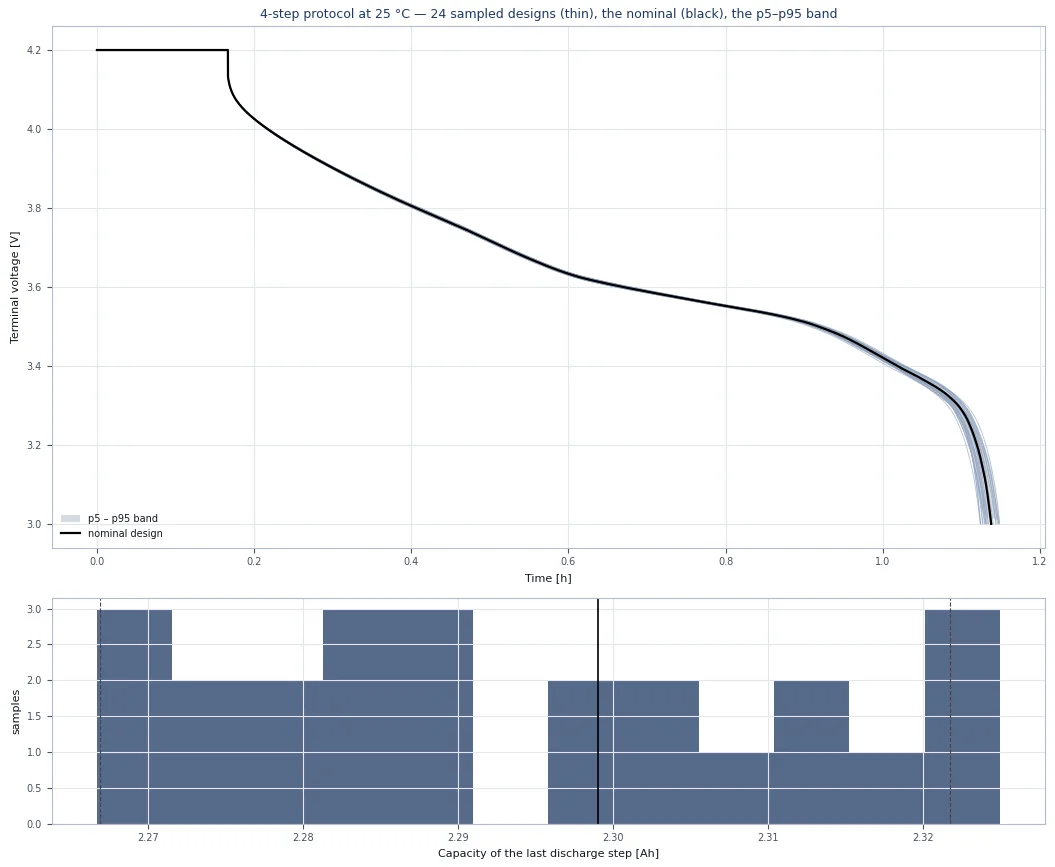
One tolerance of ±2 % on the coating thickness of each electrode moves capacity by 2.4 %.
- ±2 %
- On the coating thickness of each electrode: about 1.1 µm on 55–58 µm.
- 24 designs
- Sampled within that band, each run through the physics-based model at 1C and 25 °C. All of them in 79 seconds.
- 2.4 %
- The capacity band, p5–p95 of 2.267–2.322 Ah, from coating thickness alone. Mean voltage barely moves. Cathode-limited: the cathode coating drives it.
What it does
Seven modules, one model of your cell
- Design
- Housing, stack or jelly roll, tolerances, tabs, electrodes, electrolyte and formation; cross-section and N/P balancing.
- Simulation
- Physics-based electrochemical model (Doyle–Fuller–Newman) with thermal coupling; any test protocol.
- Sensitivity
- Which design and process parameters drive the result, and which do not.
- Calibration & data hub
- Fitting to your measurements, with provenance and uncertainty on every parameter.
- Protocol optimiser
- Test and formation protocols evaluated before they are run.
- Cycle life & degradation
- Ten degradation channels and mechanism attribution; ageing fits run as joint studies, research stage.
- Materials
- Library of active materials, electrolytes and parameter sets.
What it gives you
What it gives you
- Requirements with tolerances
- At cell and at chemistry level, so a supplier can be held to numbers.
- Fewer surprises at the gate
- The cell is tested virtually before the expensive tests are run.
- Attribution when something fails
- Which mechanism, which parameter, which process step.
- Provenance and uncertainty
- You can see where every number comes from and how sure we are.
How you get it
Delivered as a service, inside every engagement
Today the Design Tool is delivered as a service: it runs inside every Excudion engagement, operated by us, calibrated on your data, and the results come to you as a report and a model. You never need to install anything. Licences and design-study packages will follow.
Status
Status, stated plainly
Built in-house. Demonstrated on a published, open dataset (Weng et al., 2021); not yet validated on a customer cell. Runs on the test data you already have.
Designing a device where the battery is the constraint?
Let’s talk before the battery sets your schedule.
Build your next device with us